


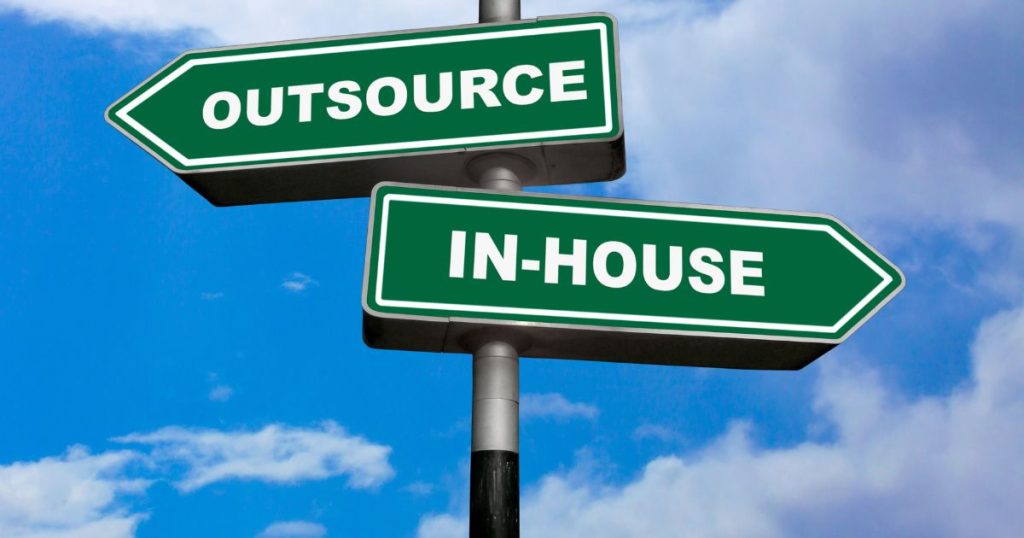
IT Outsourcing vs. In-House Technician: A Comparison for SMEs
If your company has between 10 and 50 employees and you are wondering whether it is time to hire an in-house systems administrator or continue relying on an external provider, the short answer is: for fewer than 40 workstations, outsourcing costs less and provides better coverage in 90% of cases. Above this threshold, or in contexts involving highly vertical systems (24/7 industrial production, healthcare data, proprietary software development), the equation changes, and a hybrid model becomes the most robust choice.
In our experience working with SMEs in Brescia and its province—ranging from the Valtrompia mechanical engineering district to professional firms in the city center—the question “In-house or outsourced IT?” always arises at the same junctures: when a long-standing IT technician retires, when the company grows by 5–10 employees in a year, or following a major issue that has brought office operations to a standstill for days. Let’s look at how to answer this question using hard data.
Actual cost of an in-house IT technician (beyond salary)
The cost of a corporate systems administrator is not just the gross annual salary (RAL) stated in the contract. For an SME in Lombardy, a junior-to-mid-level IT technician with 3–5 years of experience costs the company—all-inclusive—between €42,000 and €58,000 in gross annual terms. However, the true cost includes many other items:
- Gross annual salary: €28,000–€38,000 for a systems administrator with a few years of experience.
- Social security contributions and severance pay (TFR): +30–35% on gross salary → €8,500–€13,000/year
- Workstation, software, and certifications: €2,000–€4,000/year (laptop, licenses, Microsoft/Cisco/VMware courses)
- Vacation, sick leave, and time off: approximately 30–35 days a year when the company is understaffed.
- Skills gap: a single technician cannot cover everything (networks, servers, cloud, security, management software, GDPR). External consultancy is often required regardless.
The bottom line: an in-house systems administrator in Brescia costs the company a real €45,000–€60,000 per year and effectively covers 70% of IT needs. For the remaining 30%, you still need someone you can call.
Cost of an external IT partner (MSP) for an SME
An SME-focused Managed Service Provider (MSP) operates on a monthly fee model that includes helpdesk support, monitoring, security, and scheduled on-site visits. Here are the realistic price ranges for companies in the Brescia area:
- 5–15 workstations: €400–€900/month = €4,800–€10,800/year
- 15–30 workstations: €900–€1,800/month = €10,800–€21,600/year
- 30–50 workstations: €1,800–€3,500/month = €21,600–€42,000/year
For the same level of coverage, a company with 25 workstations spends approximately €15,000–€20,000 per year with an MSP, compared to over €50,000 for an in-house technician. In return, it gains a multidisciplinary team (systems administrator, network specialist, security expert, cloud consultant) rather than just a single individual.
If you want to understand in detail what a managed services contract includes, I refer you to the article “IT Helpdesk vs. Managed Service Provider: Differences.“
Benefits of corporate IT outsourcing
Corporate IT outsourcing is not just about costs. These are the benefits our clients in Brescia most frequently report after switching from an in-house model to an external one:
- Continuous coverage: no gaps during vacations, no office disruptions due to illness. The MSP team ensures continuity.
- Specialized expertise: a single employee cannot simultaneously be an expert in Windows Server, Fortinet, Microsoft 365, Veeam, GDPR, and cybersecurity. An MSP can.
- Predictable costs: fixed monthly fee instead of salaries, plus hourly rates for ad-hoc interventions.
- Professional tools included: RMM for monitoring, EDR, cloud backup, and ticketing systems. An in-house technician would have to purchase them separately.
- Contractual response times (SLAs): you know exactly how long it takes to get a response in the event of a system outage.
- Continuous updating: MSP technicians work with dozens of different infrastructures every week, bringing best practices to your company that an in-house employee would never encounter.
Advantages of an in-house IT technician
It would be incorrect to say that outsourcing always wins. An in-house technician has real strengths that are decisive in certain contexts:
- In-depth knowledge of business processes: after 2–3 years, one is familiar with every quirk of the management software, every piece of specialized machinery, and every internal procedure.
- Immediate physical presence: a problem at 9:30? By 9:32, we’re already at the desk tackling the issue. No MSP can compete with physical proximity.
- Team integration: participates in meetings, understands the business, and proposes proactive improvements.
- Direct control: everything under your own roof, with no reliance on external providers for sensitive information.
- Ongoing project management: if you are carrying out an ERP migration or rolling out 80 workstations, having someone dedicated to the project full-time is immensely valuable.
An in-house technician is cost-effective for operations with more than 40–50 workstations, or for companies with highly specific IT processes (such as production lines using PLCs, SCADA systems, or in-house software development).
Internal vs. external IT: comparison table
Here is a practical summary to help you decide based on company size:
Company size | Recommended model | Indicative annual cost |
5–15 workstations | Pure external MSP | 5.000-11.000 € |
15–30 workstations | Pure external MSP | 11.000-22.000 € |
30–50 workstations | MSP + 1 part-time internal contact | 25.000-45.000 € |
50–100 workstations | Hybrid: 1 in-house IT manager + MSP | 55.000-85.000 € |
100+ workstations | In-house IT team + specialist consultancy | 90.000+ € |
The cost-effectiveness threshold for the in-house model is indeed reached around the 50-employee mark, and it is a gradual transition point, not an on/off switch.
Outsourcing risks and how to mitigate them
It’s not all gold. Choosing between in-house and outsourced IT entails real risks that must be managed if you opt for the latter:
- Vendor lock-in: switching MSPs after three years is painful. Mitigation: always ensure you possess complete documentation and master credentials.
- Priority shared with other clients: if the MSP has 80 clients, your ticket goes into a queue. Mitigation: contractual SLAs with clear penalties.
- Physical distance: some interventions still require someone on-site. Mitigation: choose a local partner (in Brescia, not Milan or Rome) with guaranteed arrival times.
- Data security: the provider accesses your most sensitive information. Mitigation: signed GDPR DPA, provider security audit, traceable access logs.
- Costs rising over time: increasing fees, out-of-contract work, and add-ons. Mitigation: a detailed contract with a transparent price list.
To avoid signing a contract that could prove problematic, read “How to Evaluate an IT Support Quote: 8 Points to Check Before Signing.“
When to choose the hybrid model
The hybrid model—in-house IT (even part-time or junior) plus a supporting MSP—is often the best solution for growing SMEs in the Brescia area. It works well when:
- You have between 30 and 70 workstations and are growing.
- You have specialized requirements (24/7 production, custom ERP, in-house developed software).
- You want to maintain strategic control but cannot afford a full IT team.
- You have multiple locations and want a dedicated point of contact at each one.
In this model, internal IT handles routine tasks and ongoing projects, while the MSP covers security, 24/7 monitoring, after-hours emergencies, and specialized expertise (cloud, GDPR, penetration testing). It is also the model that best mitigates the “lone operator” risk: if your internal IT staff member goes on sick leave for a month, the business does not come to a halt.
For a comprehensive overview of how IT support for businesses works and the available models, you can start with our main article: Corporate IT Support: A Complete Guide for 2026.
Conclusion: go by the numbers, not your gut feeling.
Deciding between corporate IT outsourcing and an in-house technician isn’t a gut feeling—it’s a calculation made with an Excel spreadsheet in front of you. Take your current headcount, project growth over the next 24 months, tally up the true costs of the in-house model (including overhead, training, tools, and coverage gaps), and compare them against a detailed MSP quote. For 90% of SMEs in the Brescia area with fewer than 40 workstations, outsourcing wins by a wide margin. Above that size, a hybrid model is almost always the right answer.
Would you like to run the numbers for your company? We offer SMEs in Brescia and the surrounding province a free 45-minute strategic consultation: we analyze your current situation, compare the economics of different models (in-house, outsourced, hybrid), and provide a clear recommendation based on your specific figures. No contractual obligation, no technical jargon.